Commercial HVAC Services in Seattle, WA
Commercial HVAC performance in Seattle depends on more than equipment age. Rooftop units, heating systems, cooling systems, and indoor air quality controls all have to operate in a damp marine climate, under stricter local energy expectations, and across a wide mix of building types—from SoDo warehouses to South Lake Union office space and Ballard retail storefronts.
Performance Mechanical Group has served the Puget Sound area since 1985, growing from a heating and air conditioning contractor into a premier mechanical HVACR company with commercial refrigeration capabilities. For Seattle-area building owners and facility managers, that long history matters when the goal is not just getting equipment running today, but keeping customers satisfied years after the job is complete.
Why Commercial HVAC Systems Face Different Challenges in Seattle, WA
Seattle commercial HVAC systems operate in a climate that is milder than much of the country, but that does not make them simple. Damp winters, more frequent summer heat events, dense urban building stock, and evolving local energy requirements all affect how rooftop units, heating systems, cooling systems, and ventilation equipment should be sized, maintained, repaired, and replaced.
Marine moisture and year-round equipment exposure
Seattle’s marine climate exposes rooftop equipment to persistent moisture, wind, and seasonal debris. That combination accelerates cabinet corrosion, damages economizer components, affects belts and bearings, and can shorten rooftop unit life when quarterly maintenance and weatherproofing are inconsistent across the rainy months.
A cooling profile that is changing faster than many systems were designed for
Seattle commercial buildings were historically sized more heavily around heating demand, but more frequent 90°F-plus summer periods have shifted the cooling conversation. Retail, office, restaurant, and mixed-use properties now need better cooling performance and more thoughtful load planning than many older systems were designed to deliver.
Mixed building stock across Seattle neighborhoods
Commercial HVAC needs vary dramatically across Seattle. A Capitol Hill restaurant, a Fremont office remodel, a Georgetown warehouse, and a Belltown mixed-use building can all require different strategies for rooftop service, ventilation, heating installation, controls, and indoor air quality because the building age, use, and mechanical layout are so different.
Local energy performance expectations matter
In Seattle, commercial HVAC planning increasingly intersects with energy performance, electrification readiness, and building optimization. Building Tune-Ups still apply to commercial buildings 50,000 square feet and larger, and Seattle’s 2021 Energy Code remains in effect while 2024 code adoption is not expected before 2027.
Commercial Rooftop Unit Repair in Seattle, WA
Commercial rooftop unit repair in Seattle is often driven by comfort complaints, uneven cooling, poor ventilation response, economizer failures, or heating interruptions during wet winter weather. Performance Mechanical Group diagnoses rooftop problems by evaluating electrical components, controls, airflow, heating sections, refrigerant performance, and overall cabinet condition instead of treating every RTU issue like a one-part replacement.
Common failure points in commercial rooftop systems
Rooftop units often fail first at the points that cycle hardest or stay most exposed. Contactors, capacitors, belts, fan motors, ignition components, control boards, and dampers all see heavy wear, especially when units operate through Seattle rain, shoulder-season cycling, and long stretches of unattended rooftop exposure.
Heating and cooling failures often share the same root causes
A rooftop unit may show up as a “cooling problem” or a “heating problem,” but the root issue is often shared. Weak airflow, failing motors, control issues, dirty coils, poor combustion performance, or neglected maintenance can reduce both heating and cooling reliability and create repeated comfort complaints across the same zones.
Economizer, ventilation, and control problems are common in Seattle
Seattle’s climate makes economizers and ventilation strategy especially important, but these same systems can create problems when dampers stick, sensors drift, or controls fail. In commercial spaces, that can mean overheated tenant areas, unstable indoor temperatures, wasted energy, or humidity and fogging complaints near windows.
Small rooftop issues become expensive fast
An ignored belt issue, failed condensate drain, weak inducer motor, or failing ignition component can easily turn into a larger breakdown. On commercial properties, those delays affect more than one occupant—one service issue can disrupt customer comfort, employee productivity, food service operations, or tenant satisfaction across the entire building.
Commercial Rooftop Unit Installation in Seattle, WA
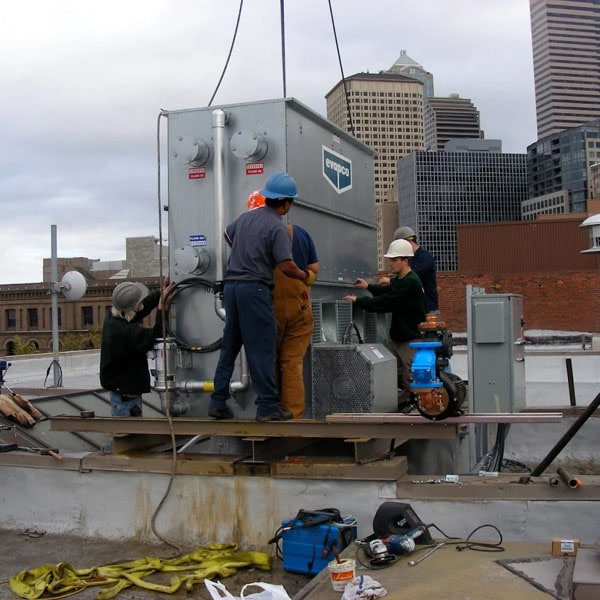
Commercial rooftop unit installation in Seattle should start with building use, load conditions, ventilation requirements, and future serviceability—not just tonnage. Performance Mechanical Group installs rooftop systems with attention to curb condition, structural coordination, controls, economizer setup, heating performance, and long-term maintainability so the equipment actually fits the building it is meant to serve.
Proper rooftop sizing and commercial load planning
Commercial equipment should not be selected by rule of thumb alone. Accurate sizing requires a commercial load approach that considers occupancy patterns, lighting loads, kitchen or process heat, ventilation requirements, solar gain, and operating schedules. In Seattle, that also means accounting for changing summer cooling expectations compared with older assumptions.
Installation quality affects long-term service cost
A commercial rooftop unit can fail early when installation shortcuts affect curb sealing, condensate drainage, airflow, gas piping, electrical service, controls integration, or commissioning. Good installation protects the owner not just from startup issues, but from years of nuisance repairs, poor zone balance, and unnecessary emergency calls.
Replacement projects often expose hidden building issues
During rooftop unit installation or replacement, contractors often discover aging duct transitions, poor roof penetrations, failing supports, or outdated controls that were hidden by the old equipment. Addressing those issues during the installation phase usually creates a more reliable and more serviceable commercial HVAC system.
Rooftop strategy should match the building type
A single-package rooftop unit may still be the right answer for many Seattle retail, warehouse, and light commercial spaces, but only when it aligns with the building’s use. The right installation strategy in Interbay may not be the right one for a Queen Anne office, a SoDo flex building, or a downtown restaurant.
Commercial Heating Installation and Repair in Seattle, WA
Commercial heating systems in Seattle must be reliable during long damp winters, especially in buildings where comfort complaints affect tenants, customers, staff, or inventory. Performance Mechanical Group handles commercial heating installation, commercial heating repair, and commercial heating service for systems that range from rooftop gas heat to larger packaged systems, furnaces, and integrated commercial HVAC equipment.
Commercial heating installation must fit real operating conditions
A good commercial heating installation should reflect occupancy schedules, ventilation needs, building envelope conditions, and distribution design. Seattle’s climate may not bring Midwest cold extremes, but poorly planned heating systems still create chronic comfort problems when damp weather, infiltration, and building use patterns are not considered correctly.
Commercial heating repair often starts with distribution complaints
In many commercial spaces, the first sign of heating failure is not total shutdown. It is one tenant too cold, one office too hot, one retail area with no air movement, or one part of the building lagging behind setpoint. Those issues often trace back to controls, airflow, staging, or heating section performance.
Furnace installation and repair still matter in some commercial spaces
Although many larger commercial buildings use rooftop or more complex mechanical systems, furnace installation and repair still matter in certain light commercial, mixed-use, and small-building applications. These systems still require proper combustion setup, safe venting, airflow matching, and maintenance to deliver dependable winter heating.
Commercial heating service protects more than just comfort
Heating service is also about tenant satisfaction, freeze prevention, operating continuity, and safety. A neglected heating system can lead to uneven temperatures, downtime, higher fuel use, short cycling, and complaints that spread quickly in occupied commercial buildings where one underperforming zone can affect the entire operation.
Commercial Air Conditioning in Seattle, WA
Commercial cooling in Seattle now plays a larger role than it did in past decades, especially in office, retail, restaurant, and mixed-use environments where internal loads and warmer summer afternoons create sustained demand. Performance Mechanical Group provides commercial air conditioning service that focuses on cooling reliability, zone stability, ventilation balance, and long-term equipment performance.
Cooling complaints are often broader than “no cooling”
A commercial cooling problem may present as humidity complaints, hot interior rooms, tenant thermostat disputes, weak airflow, or equipment that runs but does not maintain temperature under load. In shared commercial systems, those symptoms often point to controls, balancing, ventilation, or distribution issues rather than a single failed part.
Zone control and thermostat conflicts waste energy
Seattle offices and retail suites often experience comfort problems because one thermostat controls more area than occupants realize. When multiple rooms or tenant zones share controls poorly, the result can be overcooling in one area, overheating in another, and constant complaints that look like equipment failure even when the real issue is distribution logic.
Restaurants and ventilation-heavy spaces need special cooling attention
Restaurant and food-service properties often struggle when cooling, exhaust, and make-up air are not balanced correctly. In Seattle, these problems can show up as stuck doors, poor kitchen comfort, uneven dining-room temperatures, and overworked rooftop units that are trying to cool a space with uncontrolled air movement.
Commercial cooling service should include performance verification
Commercial air conditioning service should go beyond changing filters and checking pressures. It should include airflow review, control verification, economizer function, condenser and evaporator condition, tenant comfort feedback, and operating trend evaluation so the owner gets meaningful data instead of a superficial service log.
Commercial HVAC Maintenance in Seattle, WA
Commercial HVAC maintenance in Seattle is one of the highest-return investments a building owner can make when measured against energy use, emergency repair risk, and equipment lifespan. Preventive maintenance helps rooftop units, heating sections, cooling components, and ventilation systems survive Seattle’s wet climate and perform more reliably through changing seasonal loads. Many industry sources place annual maintenance plan costs around $0.12 to $0.65 per square foot, and preventive maintenance is commonly associated with strong ROI through energy savings and avoided failures.
Quarterly service is often the difference between a 12-year unit and a 20-year unit
Commercial rooftop units are often expected to last 15 to 20 years, but many fail much earlier when maintenance is inconsistent. Quarterly service helps catch belt wear, motor issues, drainage problems, dirty coils, control drift, and cabinet deterioration before they become compressor failures, heat interruptions, or emergency shutdowns.
What a commercial maintenance program should include
A useful maintenance program should include filter replacement, electrical tightening and testing, coil inspection and cleaning, belt and bearing review, heating section checks, drain and condensate review, economizer testing, thermostat or control review, and documented notes that help track recurring equipment behavior over time.
Maintenance supports both code and operating performance
For larger Seattle commercial buildings, routine HVAC maintenance also supports broader energy and operational goals. Building Tune-Ups are required for commercial buildings 50,000 square feet and larger, and ongoing maintenance makes it easier to identify the low-cost operational fixes those tune-up processes are designed to uncover.
Red flags in commercial maintenance contracts
Owners should be cautious when a contractor will not explain scope, avoids documenting findings, or quotes unusually low pricing without clarifying what is excluded. In commercial work, omitted labor, permit coordination, controls work, and rooftop access challenges can all turn a “cheap” maintenance relationship into a costly long-term problem.
Commercial IAQ Service in Seattle, WA
Commercial IAQ service matters in Seattle because indoor air quality problems often show up as comfort complaints, window fogging, stale air, odor buildup, and occupant dissatisfaction before anyone calls them an IAQ issue. Performance Mechanical Group addresses commercial indoor air quality service through ventilation review, filtration strategy, airflow evaluation, and system-level problem solving.
Ventilation problems are often mistaken for heating or cooling issues
In offices, retail suites, and mixed-use buildings, poor ventilation can look like a heating or cooling problem when the real issue is stale air, poor outside-air control, frozen coils, or weak air movement. Indoor humidity and occupant discomfort often rise when ventilation performance drifts out of balance.
Filtration and airflow affect indoor air quality more than most owners realize
Filtration only works well when the system can actually move air correctly across the filter and through the occupied space. In commercial buildings, poor duct conditions, weak fan performance, and neglected filter changes reduce IAQ performance and can worsen dust, odor, and occupant comfort issues over time.
IAQ service supports occupant comfort and business operations
Indoor air quality affects more than health messaging. It affects customer experience, employee satisfaction, product conditions, and the overall perception of the building. In Seattle commercial spaces, especially where windows stay closed during wet weather, good IAQ service becomes part of good building management rather than an optional add-on.
Moisture and fogging are warning signs worth investigating
When interior windows fog, odor complaints increase, or air feels stagnant, that often points to ventilation or moisture-control issues. In Seattle’s climate, these warning signs should be evaluated promptly because they may indicate airflow problems, cooling coil issues, or outside-air control problems that also affect energy and comfort performance.
What Building Owners and Facility Teams Can Check Safely
Commercial building staff can check a few basic items before calling for service, but rooftop equipment, electrical components, gas heat, ventilation systems, and controls should still be serviced by trained commercial technicians. The goal is not to turn staff into HVAC mechanics—it is to help them identify safe observations that speed up diagnosis and reduce avoidable downtime.
Safe checks before requesting service
Facility staff can safely note thermostat readings, occupant complaints, visible filter condition, obvious rooftop debris if roof access is already authorized, breaker status where appropriate, and whether the issue affects one zone or the whole building. That information helps technicians diagnose problems faster once they arrive.
What should always be left to a commercial HVAC contractor
Combustion adjustments, refrigerant work, rooftop electrical diagnosis, controls troubleshooting, economizer repair, and major fan or motor work should all be handled by qualified commercial technicians. These systems are more complex than residential equipment, and mistakes can create safety issues, code problems, or costly building-wide comfort failures.
When service should be called immediately
Immediate commercial service is warranted when a building loses heating or cooling broadly, trips breakers repeatedly, shows burning smells, develops water leaks near equipment, has major tenant comfort failures, or experiences ventilation issues that affect operations. In restaurants and occupancy-heavy spaces, delay can quickly escalate into a business disruption problem.
Commercial HVAC Service Costs and Planning Considerations in Seattle, WA
Commercial HVAC costs in Seattle vary widely based on building size, rooftop access, system complexity, code requirements, controls, and whether the work is reactive or planned. These prices are approximate, exact pricing requires a site-specific evaluation, but owners can still plan better by understanding how maintenance, repairs, and replacements are typically structured in commercial settings.
Annual maintenance planning
Commercial HVAC maintenance plans are often priced by square footage or equipment count, and industry ranges commonly fall between $0.12 and $0.65 per square foot annually, depending on whether the agreement covers inspection only, labor, or broader parts-and-service scope. Buildings with more rooftop equipment or tighter uptime requirements typically invest more.
Repair cost pressure usually comes from access and urgency
A straightforward rooftop issue can become expensive when crane work, roof access, controls integration, emergency timing, or multiple affected zones are involved. In Seattle, repair planning is often about reducing disruption as much as reducing invoice totals, especially in occupied retail, office, and restaurant spaces.
Installation and replacement planning should include code and controls
Commercial replacement budgets should account for more than the rooftop unit itself. Controls upgrades, curb adaptation, electrical work, test-and-balance coordination, ventilation strategy, and local code considerations can all shape the final cost of a commercial heating or cooling project in Seattle.
Why Seattle Businesses Choose Performance Mechanical Group
Performance Mechanical Group has been serving the Puget Sound area since 1985 and has grown into one of the region’s premier mechanical HVACR contractors. That long history, combined with its expansion into commercial refrigeration and its emphasis on workmanship, customer service, and integrity, gives Seattle-area businesses a contractor with proven commercial depth.
Built on workmanship, service, and long-term accountability
Performance Mechanical Group’s stated goal is not just to finish the job, but to keep the customer satisfied years after the work is complete. That mindset matters in commercial HVAC, where a contractor should be thinking about lifecycle performance, serviceability, and long-term building relationships—not just the immediate work order.
A true commercial mechanical focus
Commercial clients benefit when their contractor understands mechanical systems beyond basic residential comfort work. Performance Mechanical Group’s history in heating, air conditioning, and refrigeration gives it a broader technical perspective that fits the realities of retail spaces, offices, mixed-use properties, and other commercial environments throughout Seattle and the Puget Sound region.
Regional experience matters in Seattle
Seattle’s building stock, code environment, and climate create a very specific commercial HVAC landscape. A contractor with long regional experience is better positioned to anticipate rooftop access issues, ventilation challenges, tenant comfort complaints, and the practical realities of servicing buildings across neighborhoods from Downtown and South Lake Union to Ballard and Georgetown.
Common Commercial HVAC Questions from Seattle, WA Building Owners
This FAQ section addresses the most relevant commercial HVAC questions for Seattle building owners and facility teams, including maintenance cost, rooftop lifespan, local code obligations, contractor selection, and how Seattle’s climate affects system design. The answers are local to Seattle’s operating environment and current policy framework.
How much does a commercial HVAC maintenance plan cost in Seattle?
Commercial HVAC maintenance plans are often priced by equipment count or square footage, and common planning ranges run from about $0.12 to $0.65 per square foot annually, depending on coverage. Buildings with multiple rooftop units, tighter operational requirements, or broader labor-and-parts inclusion will usually be on the higher end.
How long should a commercial rooftop unit last in Seattle?
A commercial rooftop unit typically lasts about 15 to 20 years, but many fail earlier when maintenance is inconsistent. In Seattle, year-round moisture, rooftop exposure, and neglected quarterly service can shorten equipment life considerably, which is why preventive maintenance often makes the biggest difference in long-term RTU performance.
What is the ROI on preventative maintenance for commercial HVAC?
Preventative maintenance is widely associated with strong ROI because it reduces emergency breakdowns, improves efficiency, extends equipment life, and helps catch small problems before they affect business operations. Industry discussions often cite very high returns, and in practice the real value usually shows up in avoided disruption and better building performance.
What are the red flags when hiring a commercial HVAC contractor in Seattle?
Red flags include unusually low bids that do not explain exclusions, reluctance to discuss permits or controls, lack of true commercial experience, and failure to evaluate load or building conditions before recommending major equipment. In Seattle, business owners should also be cautious with contractors who treat commercial work like oversized residential service.
What is the Seattle Building Tune-Up requirement?
Seattle Building Tune-Ups apply to commercial buildings 50,000 square feet and larger, excluding parking, and require periodic tune-ups focused on improving energy and water performance through low- or no-cost operational fixes. Building owners should monitor deadlines by cohort and verify current compliance details with the City of Seattle.
Does the Seattle Energy Code ban gas in commercial kitchens?
The current Seattle Energy Code does not create an outright ban on gas commercial kitchens, but it does push strongly toward electrification readiness. Under the 2021 code, new commercial kitchens must provide electric-ready capacity for future electrification of gas cooking appliances.
How does the Seattle climate affect commercial HVAC sizing?
Seattle systems increasingly need to account for hotter summers than older sizing assumptions used to emphasize. While winter heating still matters, commercial cooling demand and ventilation performance now play a larger role in sizing decisions because more frequent warm-weather events can push systems harder than they were originally designed for.
Are heat pumps effective for commercial buildings in Seattle?
Yes, in many cases they are. Seattle’s moderate climate makes heat pumps a practical commercial option, especially when paired with thoughtful controls or backup heat where appropriate. They can be a strong fit for businesses trying to balance comfort, efficiency, and evolving energy expectations in the Puget Sound region.
Schedule Commercial HVAC Service in Seattle, WA
If your building needs commercial rooftop unit repair, rooftop installation, commercial heating service, cooling support, HVAC maintenance, or indoor air quality service, working with a contractor that understands Seattle’s climate, codes, and operating realities makes a measurable difference. Commercial systems perform best when they are planned, serviced, and repaired with the whole building in mind.
Performance Mechanical Group has spent decades building its reputation on workmanship, integrity, and customer satisfaction across the Puget Sound area. If you need commercial HVAC service in Seattle, call 425-251-0356 or request service online to connect with a team focused on keeping your building and your occupants satisfied long after the job is complete.